
A new synthesis method achieves uniform mixing of low-reactivity precursors
A major contribution to next-generation solar cells and displays
“Aspire to be a leader who listens and empathizes”
The key to unlocking the potential of next-generation displays and optoelectronic devices has been found.
On April 9, 토토사이트 순수익 Ko Min-jae from the Department of Chemical Engineering and his research team developed an innovative synthesis method enabling the uniform and large-scale production of perovskite nanocrystals. This achievement, praised for its precise control and high luminous efficiency, was published in a leading SCI journal. The research is expected to accelerate the mass production of highly uniform nanocrystals and advance next-generation display technologies.
We sat down with 토토사이트 순수익 Ko to learn more about his groundbreaking work leading the future of technology.
Perovskite: a core material for solar cells and LEDs
Perovskite refers to a crystal structure named after a mineral first discovered in the Ural Mountains of Russia. Owing to their outstanding optical properties—the ability to absorb and emit light—materials with perovskite structures show great potential for use in various light-emitting devices such as solar cells and LEDs. These qualities have made perovskites a key focus of global scientific interest.
Perovskite materials not only offer excellent optical and electrical properties but also allow for tunable characteristics through adjustments in size or composition. Additionally, their compatibility with solution processes makes them suitable for producing cost-effective yet high-performance energy devices.
In particular, halide perovskites exhibit distinct traits compared to conventional perovskite materials. They have shown superior performance in energy conversion electronics and are considered a promising field for future Nobel Prizes.
Overcoming existing barriers with a uniform synthesis method
Professor Ko’s non-injection synthesis method, based on precursor conversion reactions, is a new approach that enables the uniform large-scale synthesis of perovskite nanocrystals.
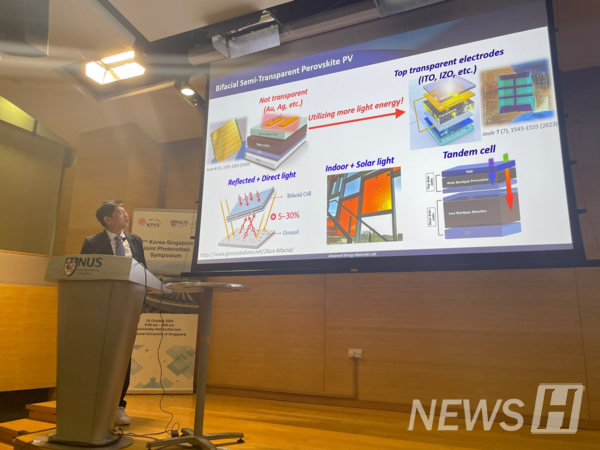
The conventional method involved injecting precursors—the raw materials of nanocrystals—into a reactor at high temperatures. However, this caused variations in temperature and concentration within the reactor, resulting in crystals of inconsistent size and reduced luminous performance and color purity (the degree to which a color expresses its specific wavelength without distortion).
To address these limitations, 토토사이트 순수익 Ko developed a synthesis method that uniformly mixes low-reactivity precursors instead of using high-temperature injection. This advancement allows for the mass production of nanocrystals with consistent size and color characteristics. It also increases the potential for application in high color-purity displays used in AR and VR and improves mass production efficiency compared to existing materials.
“Industrialization and commercialization require not only differentiated properties but also cost competitiveness through large-scale production,” said Professor Ko. “In that respect, I expect this research to make a meaningful contribution.” He added, “This work will greatly support technological advances in next-generation solar cells and displays, which can be future growth engines for Korea.”
“Striving to be an educator who inspires positive impact”
Professor Ko continues his active research as a newly appointed member of the National Academy of Engineering of Korea. Before joining Hanyang University’s Department of Chemical Engineering in 2017, he conducted research at Samsung Electronics and KIST, focusing on displays and next-generation solar cells. His current research spans high-performance energy materials and devices based on fundamental technologies, as well as smart nanomaterials.
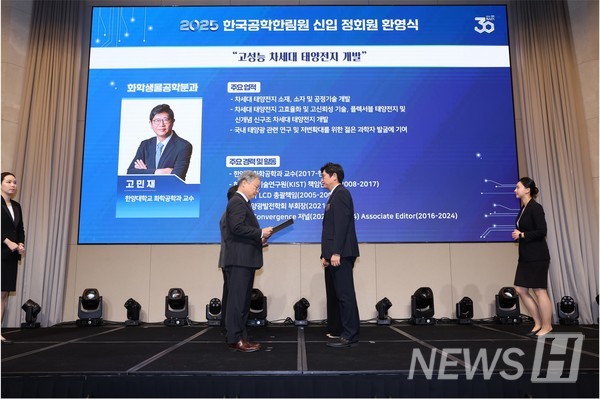
Professor Ko attributes his motivation to the dedicated graduate students he works with. “I gain energy from the discussions and debates with passionate, driven graduate students,” he said. “When we continue discussing and refining ideas to solve seemingly unsolvable problems, the moment a creative idea emerges and is realized—it’s incredibly moving.”
He also shared, “Seeing our research published in top international journals and our students contributing to Korea’s engineering development after graduation makes me determined to fulfill my role as an educator.”
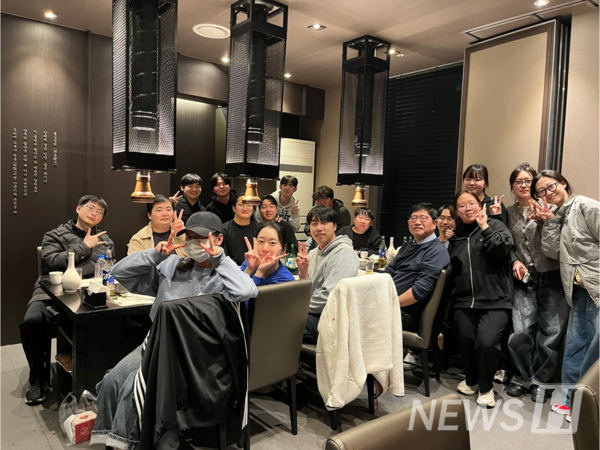
As for his future goals, Professor Ko said, “I’m currently working on developing eco-friendly, high-performance next-generation energy devices with new concepts and structures.” He added, “Through practical research that benefits real life, I aim to lead social development and contribute to the academic community by creating new knowledge.”
Finally, he offered words of encouragement to the Hanyang students:
“I truly believe every Hanyang student is a future leader in society. I hope you gain experience in resolving challenges together with your peers during your school years. Growing in society requires empathy and support from those around you.
Please also broaden your interest toward people and society. Engineering research begins with the question, ‘How can we increase benefits for people and society?’ If you add empathy and leadership to that, you will surely grow into someone who makes a great impact on the world. I wish you all a bright future!”
관련토토사이트 순수익
- HYU-KIST Joint Research Team Realizes World-Class Quantum Dot Technology through 'Special Coating' Using Low-Cost Materials
- HYU Research Team Demonstrates Memory and Depression Improvement Effects of ‘CLOVA CareCall’
- Five Graduate Students from HYU 토토사이트 순수익 Ko Min-jae’s Research Team Simultaneously Selected for NRF Fellowship, Proving Competence of Student
 '한양위키' 키워드 보기