
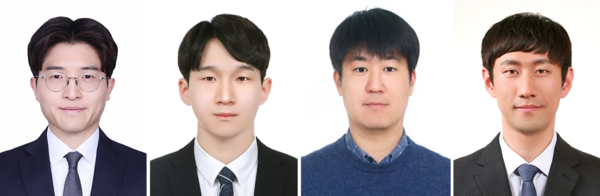
On December 8, a research team led by Professor Choi Chang-soon at the Department of Biomedical Engineering at Hanyang University and Dr. Kim Shi-hyeong of the Fiber Solution Division at the Korea Institute of Industrial Technology(KITECH) announced that they have developed a Carbon Nanotube(CNT)-based stretchable hydrovoltaic cell capable of producing electricity in static deionized water.
Existing moisture-based electric energy harvesting technologies required essential conditions such as artificial water flow, concentration differences, or pressure changes. Furthermore, the devices themselves often had non-stretchable structures, leading to common limitations of performance degradation in real-world environments. In particular, it was virtually impossible to produce electricity in deionized water due to the lack of mobile ions.
To overcome these limitations, the research team fabricated two types of CNT fibers, hydrophobic and hydrophilic, with different surface charge characteristics underwater and introduced a new design in which these are winding-locked and fixed in a double-helix structure onto an elastic rubber fiber. Within this structure, an asymmetric charge interaction occurs when the two CNT fibers come into contact with water, forming a potential difference without any separate flow or external stimuli.
The developed hydrovoltaic cell was able to continuously generate a stable voltage of approximately 0.31 V and a current of 22.4 μA/cm² simply by being immersed in deionized water. It also proved high durability and elasticity by operating without any change in output even under 200% strain conditions. Additionally, thanks to the fixed double-helix structure, it secured high mechanical durability allowing it to be directly applied to textile-type wearable platforms.
The research team successfully measured real-time voltage changes while fingers are bended by sewing the cells into a standard cotton glove. Furthermore, they successfully expanded the output voltage and capacity by connecting multiple hydrovoltaic cells in series and parallel, using this energy to directly drive a CNT-based rotary artificial muscle. Through the experiments, they confirmed its potential for expansion into various application fields such as wearable electronic devices, smart clothing, and self-powered soft robots.
Professor Choi Chang-soon stated, "This research presents the first hydrovoltaic platform capable of producing electricity with only deionized water while operating stably even in a fiber-type structure that stretches over 200%. We expect it to be utilized as a new power-integrated fiber system in various fields such as wearable devices, smart clothing, and soft robots in the future."
This research was conducted with support from the Ministry of Science and ICT, the Ministry of Trade, Industry and Energy, the National Research Foundation of Korea, and the Institute of Information & Communications Technology Planning & Evaluation(IITP). The research results were published online on November 18 in the world-renowned international journal npj flexible electronics (IF: 15.5), published by Nature. In the paper, Fully Stretchable Hydrovoltaic Cells Based on Winding-Locked Double-Helical Carbon Nanotube Fibers, Dr. Son Won-kyung and doctoral student Lee Jae-myeong from Hanyang University participated as the first authors, with Dr. Kim Si-콜로세움 토토ng and Professor Choi Chang-soon participating as corresponding authors.
관련콜로세움 토토
- 콜로세움 토토 and Sungkyunkwan University Develop Stretchable, Highly Adhesive Skin-Attachable Patch That Generates Electricity from Human Breath Moisture
- HYU 토토사이트 토토나라 Teams Develop µm-Thick Electronic Tattoos for Multifunctional On-Skin Electronics <
- HYU 레프레 토토사이트 Team Develops CNT Yarn-Based Artificial Muscle for Dual Electrical and Torsional Energy Harvesting from Humidity < 학술
- HYU 프리미엄 토토 Team Develops Multifunctional Carbon Nanotube Artificial Muscle with Enhanced Structural Stability < 학술
- Developing Stretchable Wearable Textile Devices Based on Double Helix–corrugated Structure
 '한양위키' 키워드 보기