
Suggests architecture for an intuitive space for everyone
A new platform where users are the main characters creating the culture
Harmonising with the 토토사이트 공지 by boundary-free ‘auxiliary architecture'
The team ‘MoA’, composed of Kwon Dae-hee, Yoon Jong-eun, and Hong Seung-wan (School of Architecture, Seniors), won the grand prize in the LH Park Architecture Design Competition. Hosted by LH, the competition sought new public architectural designs for application in the Third New Towns, under the theme ‘Park Architecture Embracing Culture.’ The team proposed ‘MoA,’ a new public architectural structure that dissolves the boundaries between park and building, allowing anyone to move freely and naturally.
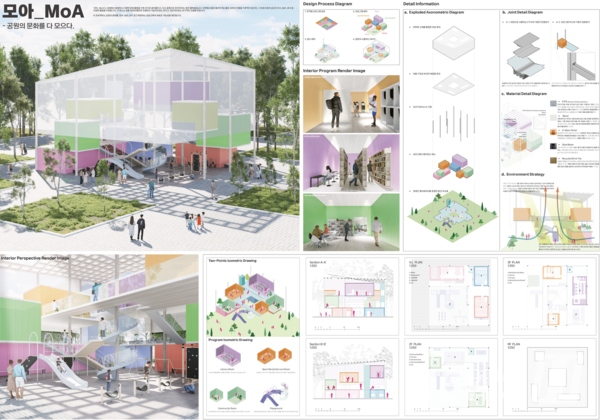
Boundary-Free Architecture, Supporting the 토토사이트 공지
The idea behind ‘MoA’ began with analyzing the limitations of existing public architecture. Kwon said, “Existing park facilities create boundaries within the park centered on buildings like libraries and art museums. We focused on the role of such infrastructure as ‘auxiliary facilities’ that blend with the existing park rather than restricting diverse park activities to happen inside a building.”
They noted that people typically visit parks for walks or relaxation, without specific goals. Kwon explained, “When you see someone playing badminton, you want to join, and if the day is nice, you want to open a picnic mat and lie down. Parks are spaces for these varied activities. Rather than a fixed building serving one purpose, we proposed architecture that supports activities already happening in the park.”
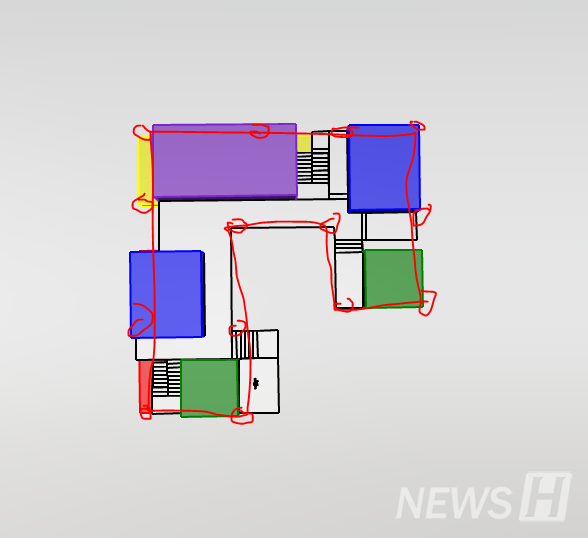
‘MoA’ minimizes the area of buildings contacting the ground by suspending spaces, arranging programs within a three-dimensional grid. This, thus, opened up possibilities for a ‘platform’ that can flexibly adjust space size and location according to each park’s purpose and user needs.
Intuitive, Enjoyable Spaces for All
The vibrant colors and shapes of ‘MoA’ were inspired by ‘children’s block boxes.’ Hong said, “Children play with blocks easily because the blocks are intuitive. Blue represents water, and green means trees; reading the space as it appears leads to comfortable use.
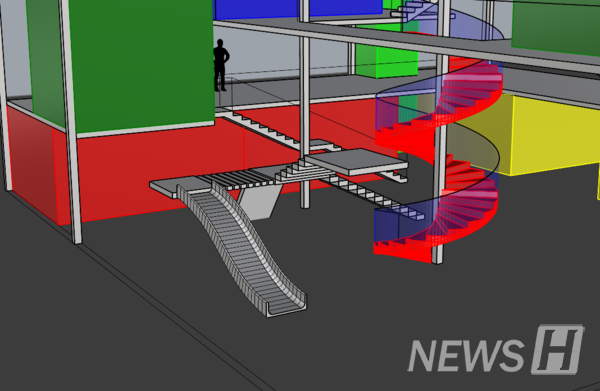
Ultimately, ‘MoA’ aims to be a playground everyone enjoys. Its colorful segmented boxes and connecting stairs evoke playground equipment. The translucent exterior material allows the building to glow like a sky lantern at night. Hong added, “We considered not only a beautiful nightscape but also practical solutions for safety in dark areas at night.”
Synergy from Perfect Teamwork
A key driver of the project’s success was strong teamwork. The team gathered from a previous park design project last semester, dividing roles efficiently across drawings, diagrams, and modeling/rendering. Kwon recalled the most memorable moment: “We hadn’t discussed concepts beforehand, but the drafts each of us brought to the meeting were similar. I felt we would work well together.”
A New Cultural Space Cultivated by the Users
Regarding the theme ‘Park Architecture as a New Cultural Space,’ the team proposed a philosophy centered on the people visiting the park. Kwon said, “New culture in park architecture is created by the people utilizing the facilities. Flexibility to be replaced by diverse facilities suitable to location and user needs is the essence of park facilities.” Yoon added, “Rather than defining new culture, we hope architecture as ‘auxiliary facilities’ will expand to strengthen the culture and activities that existing parks had.”
Their award-winning design ‘MoA’ will actually be implemented in the Third New Towns. With high expectations for the realization of their architecture, they expressed, “Chasing what’s fun and what we like led to great results. Through various experimental attempts, we plan to make Korean architecture more colorful and exciting.”
관련토토사이트 공지
- Beyond Hanyang’s Embrace—Into the World: 2024 Fall Commencement Ceremony
- Meeting Future Semiconductor Talents: Inside the 2025 토토 바카라 Tech Day <
- HTPeo, a Student Startup Developing 토토사이트 운영자 검거-Based 토토사이트 운영자 검거 Sorting Solution, Wins Minister of Environment
- 토토사이트 btsing history and friendship through art: 토토사이트 bts–Canada youth 토토사이트 bts
- 토토사이트 벤츠 Baseball Team Clinches Victory at the 80th National Collegiate Baseball Championship
- [Listening to Alumni’s Careers] Asking 팔로우 토토 Ryu Hyun-kyung About Her Life as an Actress, Now in Her 29th Year
- ASML 토토사이트 사고 팔고oratory Produces Six Doctoral Scholarship Students for 토토사이트 사고 팔고 Electronics MX Division
- From Desk Ideas to Great Inventions: HYU ERICA ‘번화가 토토사이트 Engineering Studio’ Wins Two International 번화가 토토사이트 번화가
- Business Society ‘Intuition’ at HYU Revitalizes 해외 토토사이트 순위 해외 토토사이트
- ‘Step into 올림피아토토’: 2025 Fall Semester Orientation for 올림피아토토 Freshmen 올림피아토토 < 기획 < 기획
 '한양위키' 키워드 보기