
Overcomes vulnerability to moisture and enhances stability
A research team led by 프랑스 토토사이트 Ko Min-jae of the Department of Chemical Engineering at Hanyang University has announced the development of a repeated self-healing technology that allows perovskite solar cells to restore efficiency on their own when their performance is degraded due to moisture. The study is drawing significant attention in the academic world for overcoming moisture vulnerability, a chronic issue for solar cells, and drastically improving stability, which is the key to commercialization.
Perovskite 프랑스 토토사이트 cells are evaluated as a prime candidate for next-generation 프랑스 토토사이트 energy, already achieving high photoelectric conversion efficiencies of around 27%. However, their chemical instability where internal components volatilize and the structure collapses upon exposure to moisture has been a major hurdle. While many researchers have previously focused on strengthening barrier layers, the encapsulation, to block moisture penetration, they faced the limitation that the material cannot return to its original state once decomposition begins.
Moving away from the conventional ‘blocking’ method, Professor Ko’s team focused on a mechanism that allows the material to ‘repair’ its own state. To achieve this, they introduced ‘dendrimers’—molecules with a highly branched structure like tree limbs—into the perovskite thin film. Dendrimers can contain various functional groups at high density within their structure, performing powerful chemical functions even in small amounts.
The carboxylate(-COO-) functional groups inside the designed dendrimer act as a ‘volatile reservoir’ that captures formamidinium(FA) components which typically escape during degradation via hydrogen bonding. Simultaneously, the amine(-NH) functional groups on the periphery interact with lead(Pb) to stabilize the entire material. In short, the dendrimer acts as a core engine that temporarily stores key components during degradation and re-supplies them to restore the original crystalline structure once the environment becomes dry again.
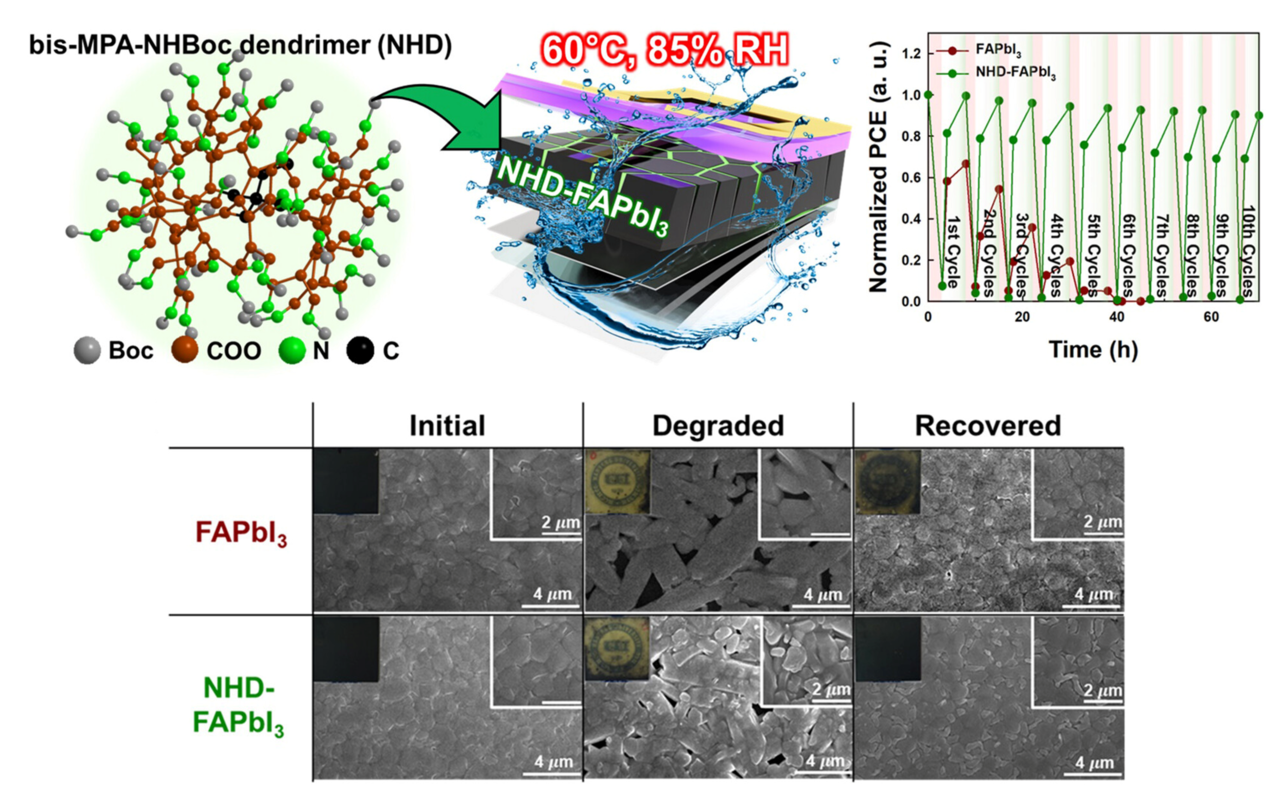
The research team proved this mechanism through experiments where devices were intentionally exposed to harsh high-temperature and high-humidity conditions before being switched back to dry conditions. The results showed that the dendrimer-based device, which achieved a high efficiency of 26.2%, recovered more than 90% of its initial efficiency even after 10 cycles of alternating high and low humidity. In contrast, standard devices without dendrimers saw a rapid and sharp decline in performance as degradation accumulated.
Professor Ko Min-jae stated, “This research is significant because it goes beyond simply suppressing the stability issues of perovskite solar cells and instead embeds a ‘recovery mechanism’ inside the material itself to recover its performance even after degradation. In the future, this concept can be broadly applied not only to solar cells but also to various optoelectronic devices vulnerable to environmental stress, such as LEDs and photodetectors.”
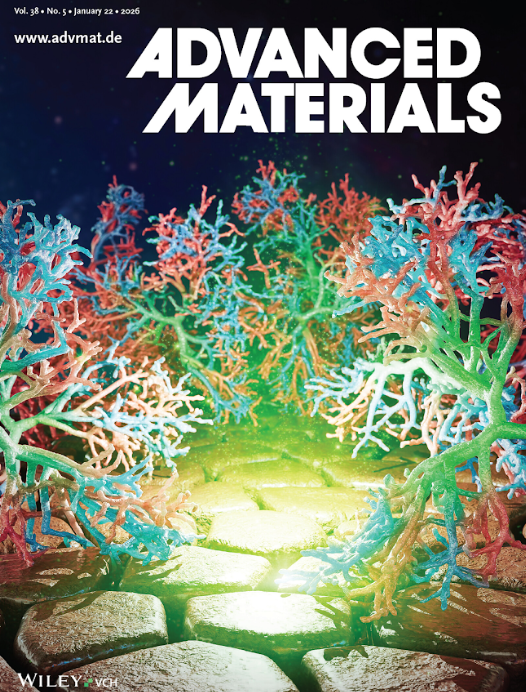
This study was conducted with support from the National Research Foundation of Korea, and the results were published as a cover paper on January 22 in Advanced Materials, a globally renowned journal in the field of materials science. The research paper, Sustainable Self-Healing of Perovskite 프랑스 토토사이트 Cells Using Dendrimers as Volatile Reservoirs, featured Hanyang University researchers Koo Bon-ki and Kim Woo-yeon as co-first authors, with 프랑스 토토사이트 Ko Min-jae serving as the corresponding author.
관련프랑스 토토사이트
- HYU Team Repurposes Mining By-product ‘Cobalt Sulfide’ as a Core Material for High-Performance Perovskite 프랑스 토토사이트 Cells
- Five Graduate Students from HYU Professor Ko Min-jae’s 그랜드토토 Team Simultaneously Selected for NRF Fellowship, Proving Competence of Student < 성과
- Sculpting Light: 토토사이트 순수익 토토사이트 순수익 Min-jae’s Innovation in Perovskite Nanocrystals
 '한양위키' 키워드 보기