
Presenting Criteria for Defining 토토사이트 하피 Topics in Cultural Contents Studies through the Three Domains of Narrative, Culture, and Industry
The Graduate School of the Department of Culture Contents at Hanyang University held a Graduate Comprehensive Seminar on December 20 at Conference Hall 101 on the ERICA campus. The seminar was designed to strengthen graduate students’ research capabilities and consisted of an integrated program covering dissertation proposals, industry trends, and international research cases.
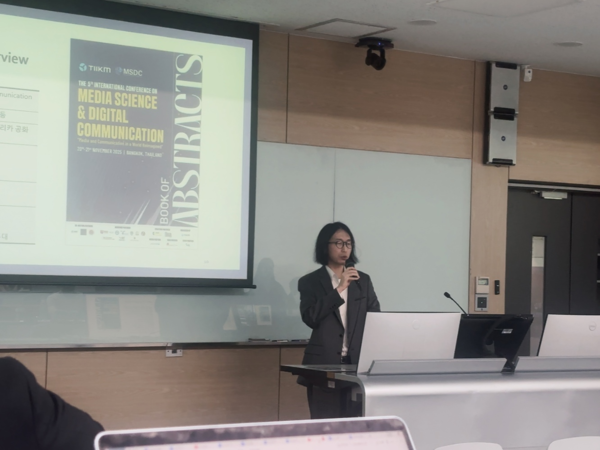
In Session 2, titled “Industry Trends and International Research Cases,” Dr. Jun Lee, Lecturer in the Department of Culture Contents at Hanyang University ERICA, delivered a special lecture focusing on real cases of presentations at international academic conferences (MSDC) and submissions to international journals (Frontiers in Communication).
In his lecture, Dr. Jun Lee emphasized that “presenting at international conferences is not about building one’s CV or accumulating experiences, but rather a critical verification process in which research questions and theoretical frameworks are examined before a study is finalized as a journal article.” He introduced his presentation experience at MSDC 2025 (Media Science & Digital Communication) held in Bangkok, Thailand, as well as the subsequent submission process that led to a special issue of Frontiers in Communication.
The lecture focused on practical issues such as how to formulate research questions required by international conferences, strategies for writing abstracts, revising research based on Q&A sessions, and designing a step-by-step research trajectory that links conferences to journal submissions. Dr. Lee noted that “in international academic venues, the primary evaluation criterion is not the precision of results, but rather the extent to which a study extends or challenges existing theories,” and explained how exchanges with international scholars reshaped the direction of his research.
With regard to research topic selection, Dr. Jun Lee introduced the Ikigai model, originating from Okinawa, Japan, and stressed that graduate research should not be reduced to a list of interests or trend-following, but must be connected to sustainable research trajectories and career planning. He explained that a research topic becomes most persuasive when it lies at the intersection of: (1) what the researcher genuinely enjoys, (2) what the researcher has developed strong competencies in over time, (3) what contemporary society and academia demand, and (4) what can be connected to one’s career and professional path after graduation. He cautioned that “if these four elements are not balanced, research may lead to early burnout or become academically meaningful yet disconnected from one’s career,” presenting the Ikigai model as a practical framework for evaluating topic selection and research sustainability.
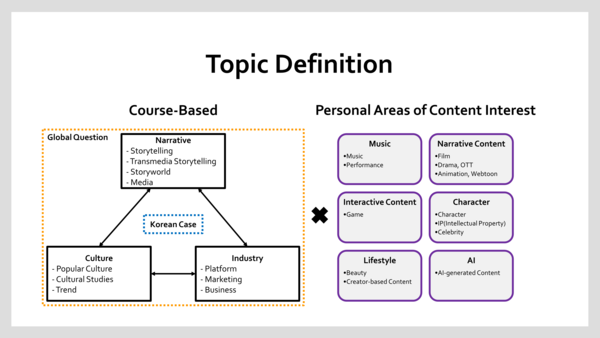
In addition, Dr. Jun Lee proposed a structural approach to defining 토토사이트 하피 topics in cultural contents studies by dividing the discipline into three domains: narrative, culture, and industry. He described the narrative domain as the dimension of content texts shaped by intentional human planning and design, encompassing storytelling, transmedia narratives, and storyworlds. In contrast, the cultural domain was defined as the realm of sensibilities, tastes, and practices that are formed organically in everyday life prior to deliberate planning, including popular culture, cultural reception, and trends. The industry domain, he explained, focuses on analyzing how narratives and cultures are interconnected, shared out of necessity, and transformed into value through platforms and markets.
Dr. Lee emphasized that “research topic selection is not about choosing something that merely seems interesting, but about first determining whether one’s object of interest is intentionally constructed, naturally formed, or a site where value is created through their combination.” He added that “even when examining the same K-pop or short-form content, entirely different research questions emerge depending on whether it is approached from a narrative, cultural, or industrial perspective,” underscoring that distinguishing among these three domains serves as a core criterion shaping topic selection, research direction, and future career paths.
He further illustrated his argument through his own research on short-form platforms and K-pop collaborations, stating that “phenomena such as algorithm-driven exposure, fan participation, and brand expansion are not merely industry trends, but subjects that can be theoretically conceptualized.” In this context, he demonstrated how concepts such as Funnel Content Condition, Fan Conversion, and Brand Expansion can be translated into international academic discourse.
Addressing graduate students, Dr. Jun Lee concluded that “submitting to international journals is fundamentally about constructing a framework that enables one’s research questions to be articulated within a global academic context,” advising students to design domestic conferences, international conferences, and journal submissions as a continuous and interconnected research process.
This special lecture was meaningful in that it presented a concrete 토토사이트 하피 roadmap grounded in real cases to graduate students who had previously viewed international conferences and journal submissions as distant goals. Participants commented that the seminar helped them understand international academic activities not as tools for career management, but as processes that strengthen 토토사이트 하피 itself.
 '한양위키' 키워드 보기