
Can ‘local’ become a 토토사이트 로그인?
Hanyang 토토사이트 로그인 SSIR Korea Center, Social Innovation Lab – Gyeongbuk Citizens’ Foundation
The Hanyang University SSIR(Stanford Social Innovation Review) Korea Center and the Social Innovation Lab held the "SSIR Monthly Colloquium" in collaboration with the Gyeongbuk Citizens’ Foundation. At the colloquium, local practitioners and students discussed new roles of universities together and identified new connections between local communities and learning, centered on the question: "Can ‘local’ become a university?"
On December 14, students from the 6th cohort of the Social Innovation Lab—part of the Hanyang SSIR Korea Center and the Business Lab at the School of Business Administration—visited Miryang and Cheongdo in Gyeongsang-do. They are currently on a project under the theme of "University Innovation." As part of this project, they co-hosted a colloquium with Root Impact’s Impact.Career team on November 3 under the theme "Journey of Universities for Social Innovation." They also translated and researched articles covering cases that solved problems beyond conventional practices, such as Mexico's Monterrey Institute of Technology and the JED Foundation in the United States. The most important question in the project is, "Where does true learning happen?" While carrying out the university innovation project, they raised questions about the role and meaning of a university and visited local sites to personally confirm the possibility of the ‘local’ becoming a university.
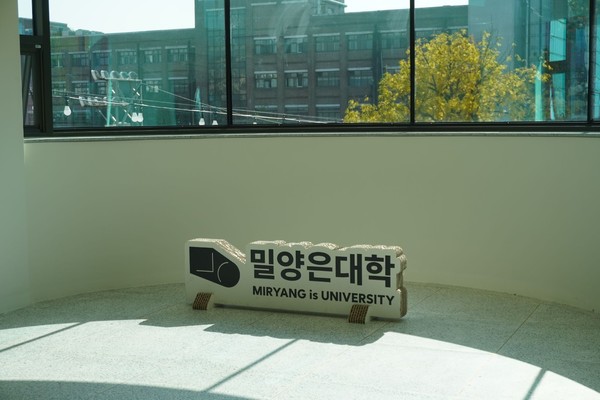
First, they visited the Miryang Communication and Cooperation Center(C.Campus) to hear an introduction to the organization and explore its interior. The Center was carrying out the ‘Miryang is University’ project. ‘Miryang is University’ is a program that connects the region with education to turn the entire city into a living laboratory, allowing citizens, students, and youth all to gain opportunities for learning and growth in their daily lives. The Center is a building constructed by remodeling the closed Miryang University. Although it was recently completed and still empty inside, offices for local entrepreneurs are expected to move in to fill up the spaces.
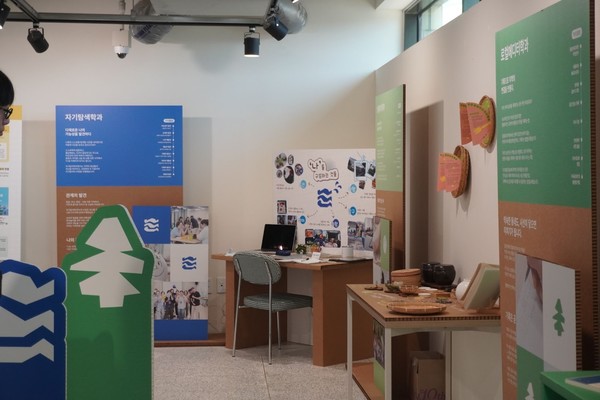
Seo Hyun-sun, a Visiting Scholar Professor at the Department of Social Innovation gave a positive reaction to the newly transformed Center, saying, "I would like to operate one semester of the Social Innovation Lab here," and "I think it would be really fun to live and work together in the local area."
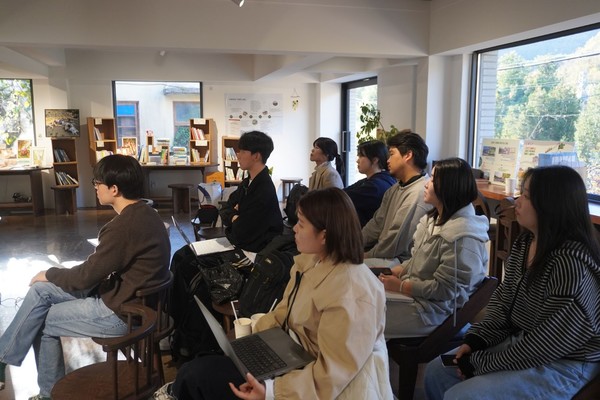
Afterward, the Hanyang SSIR Center and the Social Innovation Lab co-hosted the SSIR Monthly Colloquium with the Gyeongbuk Citizens’ Foundation. The experience of meeting local practitioners directly in a local area is an opportunity to understand how ‘local,’ a new possible form of universities, operates.
Fitting the local theme, this colloquium was held at Café Darori, a community base in Cheongdo. Café Darori is a space located in Cheongdo that began as a community project created by university seniors and juniors who moved there together. They remodeled an abandoned old public health clinic building to create a base café where everyone can rest. Currently, it serves as a community hub where local children, youth, and residents gather.
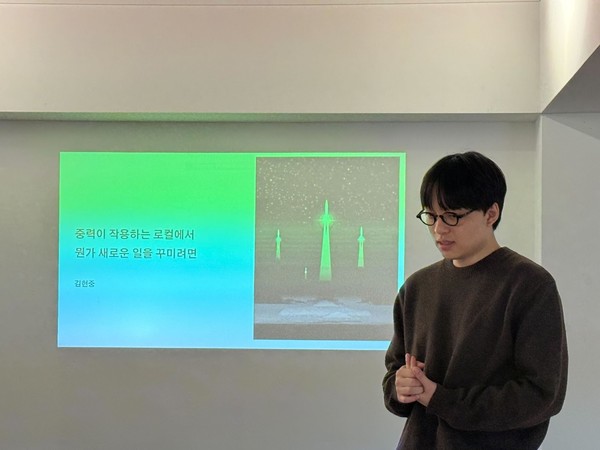
Manager Kim Hyun-joong began his presentation by introducing an article titled ‘Pacemakers Who Promote Execution.’ This article deals with how entrepreneurship took place in the Gunsan area, where there are resource shortages and psychological barriers. Applying this to university innovation, Manager Kim raised the following questions: ▲ What kind of environment is ‘local’ for attempting an innovative university? ▲ What conditions and environments are necessary for university innovation in the ‘local’ where gravity(status quo) acts? ▲ What diverse roles are needed to create such changes?
Regions that depend on a single industry collapse together when that industry falls. Therefore, regions must respond to change, and universities must do the same. Manager Kim explained the reason why understanding the local communities is important in thinking about university innovation by saying, "Innovation occurs at the periphery."
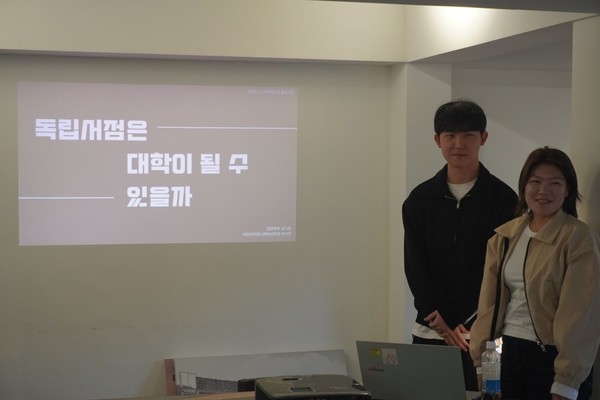
Ha Seo-yeon and Kim Ji-hwan, students from the Social Innovation Lab, presented on the topic "Can Independent Bookstores Become Universities?" The article they introduced, "Independent Bookstores Promote Community," emphasizes that bookstores should go beyond being simple spaces for selling books to become hubs for community participation and social innovation. The two students stated that independent bookstores could perform the role of a university as a local public forum and a ‘third place.’ Using Gwangju as an example, they proposed that independent bookstores in Gwangju and nearby universities form a community to communicate and collaborate. One practitioner shared their thoughts, saying, "I usually like independent bookstores, but I hadn't thought about whether they could be utilized this way," and "I think an independent bookstore could be a place for gathering rather than just a space to buy books."
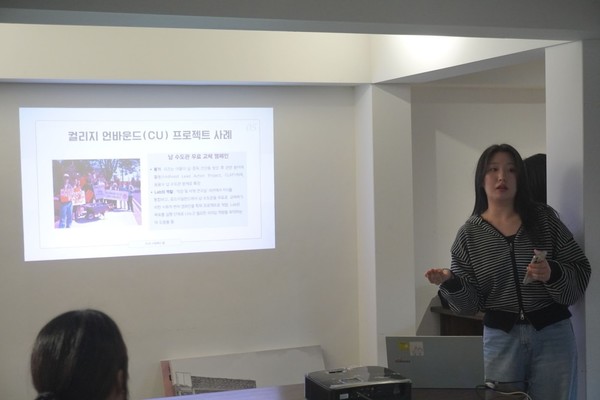
Choi Jung-eun and Ham Chae-won, students from the Social Innovation Lab, introduced the case of College Unbound(CU), one of the alternative schools in the United States. CU is a non-profit university providing meaningful and efficient education to adult learners who face high barriers to traditional university admission and completion. CU's education is centered on field projects and takes place in various spaces such as workplaces and communities. The two students considered the possibility of spreading the CU model nationwide and proposed cooperation between corporations, charities, and the government as an alternative. They also mentioned ‘Ggeokkuro(Inverted) Campus,’ a similar case in Korea, and concluded their presentation proposing the theme of ‘Learning Connected to Life.’
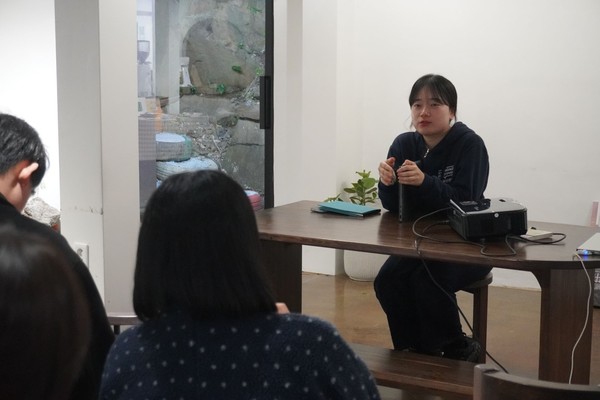
Finally, they heard the story of Manager Choi Joo-won from the Gyeongbuk Citizens’ Foundation(Cheongdo Innovation Center). Manager Choi graduated from Hanyang University and is now working at the Cheongdo Innovation Center. She shared her personal journey of choosing the region of Cheongdo and this organization. A student from NIT, under the Hanyang SSIR Center, shared the impression, saying, "It was a difficult time while preparing for employment, but I received great comfort hearing about Manager Joo-won's career concerns and her story of coming to Cheongdo."
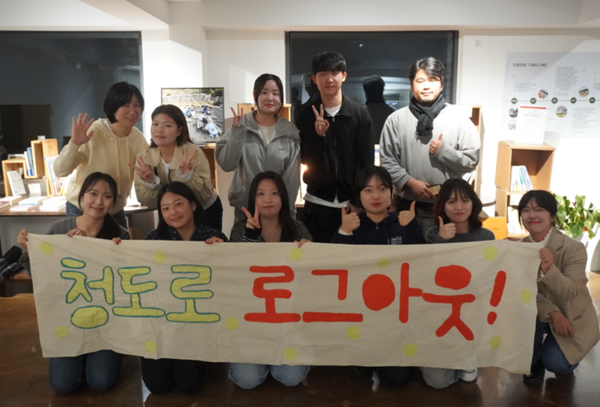
Concluding the workshop, participants shared their respective impressions and thoughts. The site became a forum for discussion where universities and locals, and students and practitioners, freely shared opinions. One practitioner said, "I was glad to hear stories from the university after a long time, and I think I heard interesting stories from the students." Another participant added, "The idea that a ‘local’ can be a space for university innovation was truly interesting."
Through this workshop, the Hanyang SSIR Center further strengthened its connection with the local area using the regional visit as a catalyst. They have established connections with the Miryang Communication and Cooperation Center and the Cheongdo Innovation Center, and are exploring a new chapter of university innovation while constantly reflecting on the question, "Can ‘local’ become a university?"
관련토토사이트 로그인
- [Photo Story] Embracing Social 토토사이트 로그인 in Hanyang’s Arms: The SSIR Monthly Colloquium
- Intercultural City International Symposium at 10th Seventeen Hearts Festival
- Hanyang 토토사이트 매입 Korea Center Highlights Role as 토토사이트 매입 Innovation Knowledge Hub at Asia 토토사이트 매입
- Global 토토사이트 블랙티비 토토사이트 블랙티비 Foundation at HYU Shares Local Coexistence Model at the 26th 토토사이트 블랙티비 Education 토토사이트 블랙티비 Workshop
- 해외 토토사이트 운영 SSIR Korea Center Hosts Impact Career Session at the '2nd Korea 해외 토토사이트 운영 Value Festa'
- Answering 해외 실시간 토토사이트 in Our Own Words: 해외 실시간 토토사이트 Hosts Deliberative