
A real-time drone control system utilizing electromyography(EMG) signals developed
Ideas derived from wildfire disasters; major courses served as a strong foundation
“Defining the problem beyond technology is key; dreaming of commercialization to help patients”
The 'Corn Interns' team, composed of students from Major in Biomedical Engineering, School of Electrical and Biomedical Engineering, developed a real-time drone control system utilizing electromyography(EMG) signals, winning 2nd place in the 5th MATLAB 파주 토토사이트 Competition. Having researched day and night for a month to enhance technical sophistication, they were pr파주 토토사이트sed for presenting an alternative to overcome limitations at disaster sites.
Combination of course content and social concern: 'Corn Interns'
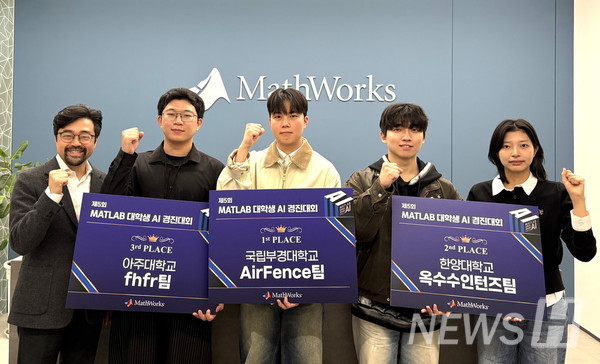
The team name 'Corn Interns' originated from the English name of their laboratory, the Computational Intelligence & Neural Engineering Lab(CoNE Lab). Choi Hee-jin(Major in Biomedical Engineering, senior) explained, "The laboratory name 'CoNE' sounds similar to the word 'Corn,' so we used to call it that jokingly, and it eventually became our team name." The team was formed by three seniors in Major in Biomedical Engineering who were active as undergraduate researchers in the same lab.
The research began with an interest in social issues. Choi stated, "Large-scale forest fires were a major issue at the time of the competition, so we were looking for a topic that could provide practical aid in disaster situations. Leveraging the characteristics of our major, we applied EMG signals, which we handled in a project in a course last year, to drone control."
The major course 'Biomedical System Design Project' served as a solid foundation. Choi added, "Thanks to the course where I had hands-on experiences in everything from circuit soldering to signal measurement, I was able to utilize EMG-related technology without much concern."
Real-time drone control via EMG signals
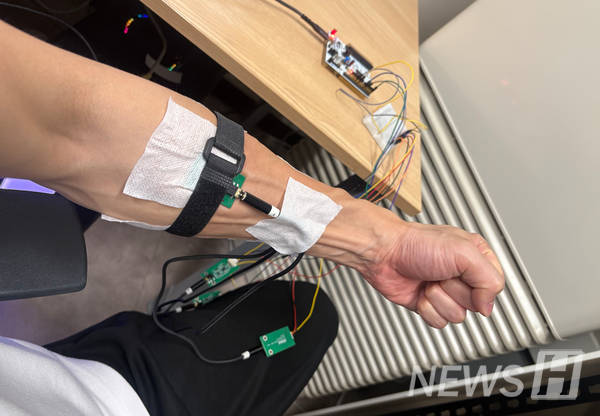
The system they developed controls a drone by detecting the electrical activity of muscles with an EMG sensor worn on one arm. By reading the difference between muscle contraction and relaxation according to movements as electrical signals, they achieved real-time 6-direction control of the drone: forward, backward, left, right, up, and down.
The core lies in a deep learning model that accurately classifies the patterns of EMG signals, which are unstructured data. Choi explained the technical structure: "We designed a model that converts signals from three channels into a time-frequency map, extracts features through a CNN(Convolutional Neural Network) for each channel, combines them, and passes them through an LSTM(Long Short-Term Memory) stage."
Additionally, they used 'App Designer' to measure signals in real-time and verify data collection and classification, and utilized 'Simulink' to reproduce and control the actual movement of the drone. Choi said, "The strength of our technology is that the altitude and direction can be controlled intuitively with the movement of just one arm."
The development process was not entirely smooth. The biggest problem was the stability and accuracy of real-time control. Recalling the difficulties at the time, Choi said, "Since AI classification results cannot be 100% accurate every moment, the drone would often fluctuate sharply if a wrong value was entered."
To solve this, the team added original logic. Choi said, "We classified a total of 8 movements, including hovering, where the drone stays at its spot flying, but we improved the precision of control by ensuring the next command is only executed when the 'stop' signal movement is clearly recognized." She added, "While hovering, the previous command is maintained." Furthermore, to solve the real-time time synchronization problem between App Designer and Simulink, they went through a revision process to integrate the operating environment inside Simulink.
Dreaming of being an engineer who contributes to patients’ lives beyond the technology

While preparing for the competition, Choi got to realize one crucial competency as an AI developer. She emphasized, "Technical capability is important, but I felt that the ability to define the problem situation is the most important. This is because you can only follow the appropriate solution process if you set a clear sense of purpose."
The potential for expanding real-time drone control technology is endless. Choi said, "Control using biosignals can be utilized in various fields such as rehabilitation or industrial sectors." She added, "While much research is already underway, there are many large tasks until commercialization in the field. I hope technology develops in a direction where it can be used more easily and accurately in real life, like this research project."
Choi is dreaming bigger, using this award as a stepping stone. She shared her ambition: "I plan to go to graduate school next year to deeply study Brain-Computer Interfaces(BCI). Beyond simple research, I want to become an engineer who builds systems that substantially contribute to patients' lives."
Finally, to fellow Hanyangians who are hesitant about participating in competitions, she left a message of support: "This is my first award after several failures. Even if you don't win, you still gain great competencies in the process of challenging yourself, so if you have like-minded colleagues, don't hesitate and just give it a try."
관련파주 토토사이트
- HYU Campus Safety Department Wins Minister of Public Administration and Security Award for Two Consecutive Years
- 토토사이트 동화 코드 Production Project of Non-토토사이트 동화 코드 Students, 'Blended on
- From 토토사이트 러쉬 Aces to KBL Rookies: Meeting Players 토토사이트 러쉬 Seon-woo, Park Min-jae, and Shin Ji-won
- [HanChingChan] Delivering ‘Love of 토토사이트 사라짐’ to Revive Daily Lives: Spring in 토토사이트 사라짐 Envisioned by Alumnus 토토사이트 사라짐 Yang-goo <
- [Photo 토토사이트 은행 조회서] Looking Back, The Campus Shining with Winter Decorations Every
- 'Excited Lions,' 무신사 토토사이트 Dep무신사 토토사이트ment of Applied 무신사 토토사이트 무신사 토토사이트 Wins Silver at 2025 KOSAC Video
 '한양위키' 키워드 보기