
Dr. Kim Chan-hoon’s team at Hanyang University realizes long-lasting 토토사이트 메인 디자인 anodes by suppressing dendrite formation

A joint research team led by Dr. Kim Chan-hoon, research professor at the Department of Chemical Engineering, Hanyang University, and Professor Song Joo-hyun at the Korea Institute of Energy Technology (KENTECH) has developed a polymer protective layer that fundamentally suppresses dendrite formation, one of the major technical challenges in aqueous 토토사이트 메인 디자인-ion batteries (AZIBs). This breakthrough significantly enhances the practical commercialization potential of AZIBs.
Although AZIBs have lower energy density than lithium-ion batteries, they are safer due to their water-based electrolytes and virtually no fire risk. They also offer a cost advantage, with raw material costs at about one-third of lithium-ion batteries. As a result, they have recently garnered attention as secondary batteries for indoor use, zero-energy buildings, and energy storage systems (ESS) for data centers. However, the formation of dendrites—sharp, needle-like structures on the zinc anode surface during repeated cycling—has posed a major obstacle, leading to shortened lifespan and potential short circuits.
The joint team addressed this issue by focusing on the imbalance of zinc-ion concentration at the anode surface. They designed a functional polymer protective layer that selectively allows only zinc ions to pass through. Despite being ultrathin at about 4 μm, the layer achieved a world-class zinc-ion transference number of 0.91, enabling uniform zinc plating and stable cycling without dendrite formation.
Unlike previous studies that used thick zinc foils regardless of utilization efficiency, this team applied their protective layer to a 14 μm ultrathin zinc foil, improving its practical applicability. Even under a low NP ratio (anode/cathode capacity ratio) of 3.3, this configuration retained 75% of its capacity after 5,000 cycles, demonstrating outstanding long-term performance.
The researchers also succeeded in uniformly applying the protective layer to a large-area zinc anode measuring 80 cm², confirming scalability in large-area manufacturing processes. The large-area pouch cell (300 mAh) using this anode achieved a capacity over 100 times greater than typical laboratory-scale coin cells and maintained 96% capacity retention after 500 cycles.
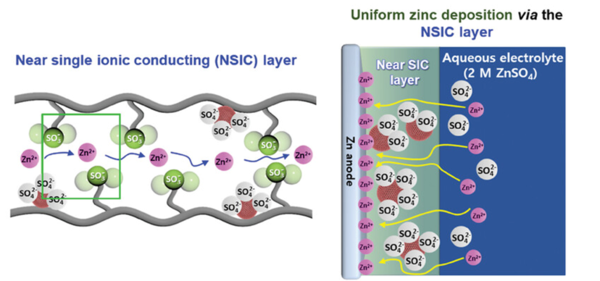
Dr. Kim Chan-hoon stated, “We have successfully demonstrated that a functional polymer protective layer selectively allowing zinc-ion transport is highly effective in suppressing dendrite formation,” adding, “The technology was designed for scalability, making it a practically viable solution for commercialization.”
This 토토사이트 메인 디자인 was supported by the STEAM 토토사이트 메인 디자인 Program (Pioneer Program for Convergence Technology) funded by the National 토토사이트 메인 디자인 Foundation of Korea and the Convergence 토토사이트 메인 디자인 Program funded by the National 토토사이트 메인 디자인 Council of Science & Technology. The results were published in the June issue of Advanced Energy Materials (IF = 26, top 2.5% in JCR). The paper, titled “A Near-Single-Ion Conducting Protective Layer for Dendrite-Free Zinc Metal Anodes,” lists Dr. Kim Chan-hoon of Hanyang University and Professor Song Joo-hyun of KENTECH as corresponding authors.
Meanwhile, Dr. Kim’s team completed a technology transfer to TNP Solution Co., Ltd. in March 2025. Established in May 2019, TNP Solution started as a telecommunications equipment manufacturer and has since expanded into the energy and safety solutions sectors. Based on this technology, the company is preparing for mass production of AZIBs in the first half of 2025.
Click to see the paper:
 '한양위키' 키워드 보기