
Professor Lee Joon-seok, Department of Chemistry
Professor Lee Joon-seok recently developed a three-dimensional porous 토토사이트 은행 조회-network coating technology in collaboration with Professors Park Jung-hoon and Kim Do-hoon at Asan Medical Center. This technology dramatically improves the adhesion between the esophageal wall and stents, significantly enhancing stent fixation. The results of this study were featured as a cover article in Advanced Materials this March.
Written by Park Young-im / Photos by Son Cho-won
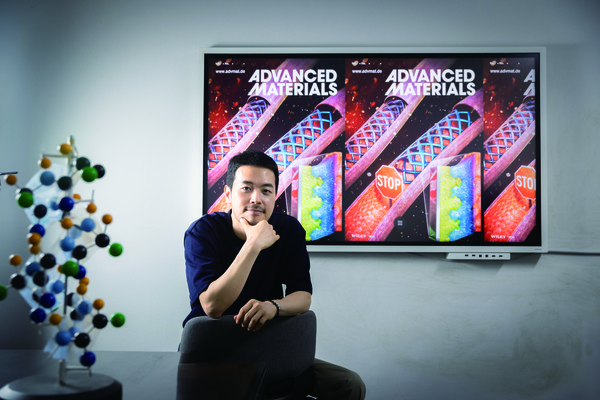
■ Enhancing stent fixation in the body by 100 times
Esophageal stricture, caused by inflammation, injury, or tumors, narrows the esophagus, making swallowing difficult and causing pain. With aging populations and rising cancer rates, the number of patients suffering from esophageal strictures is increasing. Stent procedures are commonly performed to widen narrowed esophageal passages, but current stents often dislodge easily. In fact, the dislodgement rate in patients is as high as 30%, leading to repeated procedures and increased patient pain and costs.
To address this, Professor Lee’s team developed a “nano-puzzle adhesion technology (HiRINC),” which involves coating the stent surface with a 3D nano-network structure and filling it with bio-adhesives.
“Traditional non-vascular stents require flares or hooks for fixation, which makes the procedure complex and can cause tissue damage, dislodgement, or foreign body sensation. We aimed to create a stable fixation technique. This technology combines silica-based 3D nanostructures with biocompatible hydrogels, providing strong adhesion capabilities to the metal stent surface through a high-adhesion nano-interface.”
This approach uses a dual adhesion mechanism—mechanical interlocking and hydrogen bonding—allowing the stent to remain firmly in place without suturing. The technology increases the adhesive strength of bio-adhesives more than 100-fold compared to existing methods, effectively preventing stent dislodgement. It also reduces inflammatory responses and tissue hyperplasia while suppressing adhesive swelling in moist environments, demonstrating excellent biocompatibility.
“Our bodies have many ducts, such as in the digestive, respiratory, and urinary systems. This core technology can be applied to these ducts and other implantable medical devices. With increasing pet lifespans, demand for animal stents is also rising, and we plan to expand applications to veterinary use in the future.”
■ Developing functional 토토사이트 은행 조회 materials for healthcare
In 2023, Professor Lee Joon-seok collaborated with Professor Lee Dong-yoon from the Department of Biotechnology and Professor Kim Young-pil from the Department of Life Science to develop a technology capable of detecting cancer cells in vivo and heating surrounding water molecules for treatment.
Professor Lee’s collaboration on stent research with Asan Medical Center began in 2018, before he joined Hanyang University’s Department of Chemistry. At that time, he was serving as a principal researcher at the Korea Institute of Science and Technology (KIST). Their first joint outcome was a stent with drug delivery capabilities. Later, Asan Medical Center proposed a second project to address the serious issue of stent migration, leading to further collaborative research.
Beyond this, Professor Lee has been involved in various joint 토토사이트 은행 조회 projects. In 2023, he again teamed up with Professors Lee Dong-yoon and Kim Young-pil to develop multifunctional nanoparticles capable of identifying cancer cells and enabling local photothermal therapy by heating water molecules around them. This technology, which provides long-lived near-infrared signals and localized heating for photothermal treatment, was published in the prestigious journal Nature Communications in May 2023 and is expected to be applied to the diagnosis and treatment of malignant brain tumors in the future.
The same team also developed nano materials that can remain in the intestines for extended periods and effectively eliminate reactive oxygen species (ROS), demonstrating sustained anti-inflammatory effects and tissue regeneration in animal models. In another collaboration with Professor Jeon Dae-won from Hanyang University’s Department of Medicine (Division of Gastroenterology), Dr. Lee Hyun-beom, and Dr. Park Jin-young at KIST, Professor Lee is developing nano materials designed to selectively break down lipid droplets and absorb lipids for treating non-alcoholic steatohepatitis (NASH).
Although affiliated with the Department of Chemistry, Professor Lee has been actively engaged in disease treatment 토토사이트 은행 조회 through collaborations with faculty from medical and life science fields. His pursuit of healthcare-related applications stems from his core expertise: developing synthesis technologies for diverse functional materials at the nano scale.
“All the cells, bacteria, viruses, and nutrients such as carbohydrates in our bodies fall within the nano scale. To deliver antibodies, enzymes, and drugs for treatment or imaging inside the body, we must utilize functional materials at this scale,” Professor Lee explained.
■ Aiming for market release within five years through lab startup
Interestingly, Professor Lee originally majored in materials science engineering. Focused on developing nano materials for bio-industrial applications, he later accepted a faculty offer from Hanyang University’s Department of Chemistry, embarking on a new path as a chemist. While emphasizing practical, application-oriented research, he always felt a strong pull toward basic science. Expecting that a solid foundation in fundamental research would enable him to tackle broader challenges, he joined Hanyang University and saw a significant improvement in the quality of his research outcomes.
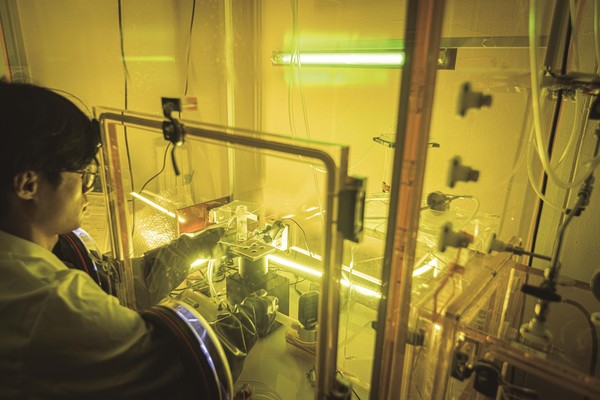
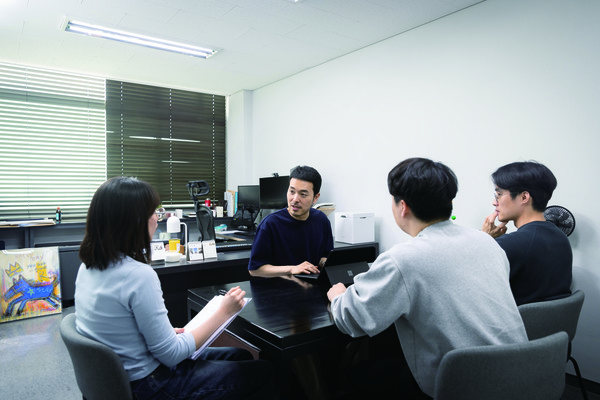
While devoting himself to his various research projects, Professor Lee also actively engaged as a “chemistry communicator” to promote the excitement and importance of chemistry to the public. In March, he appeared in the EBS documentary program DocuPrime, in an episode titled “Chemistry Beyond Expectations,” which explored how chemistry is deeply intertwined with everyday life.
“I wanted to contribute to the popularization of chemistry. As a researcher, I believe it’s also our responsibility to convey the value of science and help the public access it easily. Most people think of chemistry as a difficult, distant field. So when EBS proposed making a program to promote chemistry, I participated in planning for about a year and also appeared on the show,” Professor Lee said.
Alongside his efforts to popularize chemistry, Professor Lee never lost sight of his goal as a researcher to create work that truly benefits society. Recognizing the market potential of his stent technology, he founded a lab-based startup named VN (Versatile Nanoplatform) in 2022. VN aims to obtain Korea’s Ministry of Food and Drug Safety approval for non-vascular stents applying its nano-puzzle adhesion technology within five years and is accelerating follow-up research toward this goal.
“During my Ph.D. years, I deeply contemplated what kind of researcher I wanted to become. I decided that I should pursue research that society needs and that can actually help people in real-world applications. It’s crucial to think deeply about how you want to live your life. Once you set a goal, keep pushing forward with determination,” he emphasized.
Seeing his research outcomes transformed into products practically used in society has been Professor Lee’s long-cherished dream. These days, he is working with growing excitement, believing that this dream may come true sooner than he once imagined.
This article was published in the Summer 2025 issue (No. 274) of HYPER, Hanyang University’s official magazine.
관련토토사이트 은행 조회
- HYU 토토사이트 은행 조회 Team Develops 3D Stacked Memristor Array
- HYU 토토사이트 번호 차단 Team Develops Oral Nanomedicine Platform for Treating 토토사이트 번호 차단 Bowel Disease <
- The Journey of Studies and Education Coming to an End at 보스토토 < 기획
- 토토사이트 은행 조회 Team Led by HYU Professor Develops Real-Time Tracking Technology for Brain Astrocyte Reprogramming
 '한양위키' 키워드 보기