
World’s smallest 토토사이트 위치 cluster, (CdSe)₁₃, reborn as a sustainable photocatalyst
Overcoming previous limitations through suprastructure assembly and bipyridine-based molecular catalysis
Hydrogen has gained global attention as a next-generation clean fuel thanks to its eco-friendliness and economic viability. Among various production methods, photocatalysis—which utilizes sunlight to split water molecules—has emerged as a promising sustainable approach. A photocatalyst refers to a material that absorbs light to release electrons, which in turn decompose water molecules to produce hydrogen.
Professor Jang Yoon-jeong of the Department of Chemical Engineering at Hanyang University, in collaboration with research teams from DGIST and Korea University, has succeeded in using the world’s smallest semiconductor cluster as a photocatalyst for hydrogen production—a first in the world.
The research team employed the (CdSe)₁₃ cluster—a cadmium selenide (CdSe) nanocluster that had never before been used as a photocatalyst. As the smallest CdSe semiconductor cluster to date, (CdSe)₁₃ features a high proportion of surface atoms, offering great catalytic potential. However, due to its structural instability, practical application had remained elusive.
To overcome this limitation and enable hydrogen production, the team undertook three major steps. First, they doped the (CdSe)₁₃ cluster with cobalt ions (Co²⁺) to enhance its electrical properties. Then, they guided the cluster to form a stable 3D suprastructure. Finally, they designed a catalytic environment suitable for hydrogen production. DGIST focused on suprastructure formation, while Professor Jang’s team led the catalytic system design.
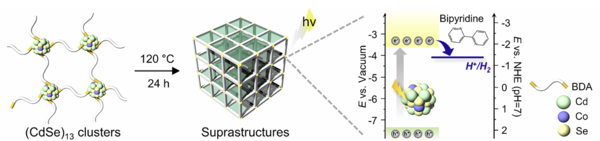
Doping the (CdSe)₁₃ clusters with cobalt ions increases light absorption and extends the lifetime of photoexcited electrons—an essential condition for water splitting and hydrogen generation. After undergoing a 24-hour heat treatment, the clusters form a stable suprastructure.
However, like many other semiconductor nanomaterials, the (CdSe)₁₃ cluster lacks sufficient active sites required for catalytic reactions. To address this, the team introduced a molecular catalyst—bipyridine—that offers additional active sites and facilitates hydrogen production.
This study is significant in that it successfully transformed a previously unstable and inactive nano토토사이트 위치 into a functional photocatalyst. Nanomaterials are known for their high surface-area-to-volume ratio, making them theoretically ideal for catalytic applications. However, they often lack structural stability and active catalytic sites. The (CdSe)₁₃ cluster, which originally had both issues, was successfully reborn as a stable and eco-friendly photocatalyst through this work.
The method holds considerable promise not only for environmental and energy applications but also in quantum science. Since it generates 토토사이트 위치 using only light, it presents an ideal green energy solution. Moreover, by coupling the cluster with various molecular catalysts, it may be possible to produce other high-value-added chemicals beyond 토토사이트 위치.
Another major contribution of this work is that it demonstrated control over materials at the nanometer scale—an area often considered too complex for classical physics models to fully capture. This study offers a concrete example of the untapped potential in semiconductor nanoclusters.

Professor Jang, who joined the Department of Chemical Engineering at Hanyang University in 2020, has been conducting catalytic research, particularly in the development of photocatalysts and electrocatalysts for alternative fuels and value-added chemical 토토사이트 위치.
Supported by the National Research Foundation of Korea, the study was published in the international journal Nano Letters under the title “Photocatalytic Hydrogen Production Using Semiconductor (CdSe)₁₃ Clusters.”
 '한양위키' 키워드 보기